I'm a failure, and that's a good thing.
I had a good start in National Novel Writing Month, staying consistently ahead of the goal for the first week. Ideas came fairly easily, kept flowing day after day with a good part at the end of each session to keep the story moving. The second week, I was going well, which is fairly unusual. The second week is typically difficult for people because they realize that the ideas aren't as smooth and that writing is hard work.
My problem was totally different. I got a job where they wanted me to start right away, work from 8 am to 9 pm every day, and take notes the whole time. By the time I got home, I didn't want to write any more. I ended up exhausted, I couldn't get back into the rhythm after that, and then I had a huge paper due for one of my school classes that took priority over the novel because there's a grade attached to the one for school.
This was a good exercise in priorities for me, deciding what's really important and what I can let go of for a little bit. Sadly, the event I'd been looking forward to for a year is what got cut this time. I also wrote more words for my novel in November than I had the entire previous year. I've still got plenty of the story to tell, so I can work on that in the next bit. I've also decided that I'm taking a totally different tack with next November. I think I'm not going to plan my novel at all next year. I may come up with a title and that's it.
Maybe. We'll see.
Showing posts with label books. Show all posts
Showing posts with label books. Show all posts
Friday, December 3
Friday, November 5
Holy busy November!
Happy NaNoWriMo! I'm right in the middle of writing my novel and things are going well. Next week, I'm going to feel stuck, I can just feel it coming. But as it is, I'm keeping ahead of the game, despite my life being completely crazy with school presentations, job hunting and being an attentive parent.
I've already done a couple of things with my story that surprised me, the biggest one being that the point of view is not the third person omniscient that's so common. It's not even the normal kind of first person narrative. It's so far inside the character's head like Catcher in the Rye. There's stream of consciousness narrating to some unknown party. Totally hadn't expected that. I was actually fully planning on writing the story in third person. But that's what the month is all about, right?
Here's my favorite little bit I wrote today:
Here's my favorite little bit I wrote today:
Envelope safely tucked into John Tesh, I headed out of the store. Did I just say “envelope tucked into John Tesh?” There’s a phrase I hadn’t expected to say ever in my life.Fun, right? If you're taking on writing a novel this month, good luck. And if you need some encouragement or maybe a suggestion to make your story better or keep it moving, please let me know. I like to help. Back to my adventure.


Thursday, September 30
Book Academy
Today I went to The Book Academy, a writing conference at UVU, and enjoyed myself. It was fun meeting with people like me who love words and nice to be around people who don't talk about their characters like that one guy in one of my college writing classes who said that his characters weren't doing what he wanted them to do. (My teacher looked at him like he had celery growing off his face and said, "You're the author. You get to pick what they do because you're God to them." And that reminded me of when Kilgore Trout gets to meet Kurt Vonnegut in Breakfast of Champions.)
It was fun to learn more about the industry and though I would have liked to get more into the business end of things, the conference wasn't about that. It was still fun and I met some interesting people. Writers are a fascinating bunch. I don't just say this because I consider myself one, they really are interesting to talk to because they generally have more things going on in their heads than most people.
I'm also kinda bummed that I don't have enough of a handle on my place in the industry because it would change how I would relate to people. I didn't network as well as I wanted to, and I have no one to blame on that but myself. I'm not the kind of person who goes around the room like the typical business major. I've got to find my stride on that kind of networking and I'm not there yet.
Can you tell that I've discovered a number of weaknesses today? The trick now is to work on fixing them.
If you didn't hear about it, they're going to have it again next year. Come with me, will you?
It was fun to learn more about the industry and though I would have liked to get more into the business end of things, the conference wasn't about that. It was still fun and I met some interesting people. Writers are a fascinating bunch. I don't just say this because I consider myself one, they really are interesting to talk to because they generally have more things going on in their heads than most people.
I'm also kinda bummed that I don't have enough of a handle on my place in the industry because it would change how I would relate to people. I didn't network as well as I wanted to, and I have no one to blame on that but myself. I'm not the kind of person who goes around the room like the typical business major. I've got to find my stride on that kind of networking and I'm not there yet.
Can you tell that I've discovered a number of weaknesses today? The trick now is to work on fixing them.
If you didn't hear about it, they're going to have it again next year. Come with me, will you?
Thursday, September 16
What comes first?
Booking Eddie Van Halen or having a triumphant video?
That's one of the things I'm trying to figure out with what I want to do with this SixUnpossible site I've got. It seems like a classic Van Halen-and-the-video conundrum.
Kind of like why Facebook is so popular or why Paris Hilton's famous. Facebook is so popular because it's popular and Paris Hilton's famous because she's famous. It's tautological and kind of maddening. I'm thinking of doing something related to books, but I still don't know enough about the industry or have a clear enough vision of where I fit into the future of books to have a chance. I'm still learning, but soon, very soon, I think I'll have a plan and a vision and be looking for a place to make it happen.
That's one of the things I'm trying to figure out with what I want to do with this SixUnpossible site I've got. It seems like a classic Van Halen-and-the-video conundrum.
Kind of like why Facebook is so popular or why Paris Hilton's famous. Facebook is so popular because it's popular and Paris Hilton's famous because she's famous. It's tautological and kind of maddening. I'm thinking of doing something related to books, but I still don't know enough about the industry or have a clear enough vision of where I fit into the future of books to have a chance. I'm still learning, but soon, very soon, I think I'll have a plan and a vision and be looking for a place to make it happen.
Friday, August 20
I took a little break
 Image via Wikipedia
Monday, August 16
Typography
I just read a book entitled How to Spec Type because I wanted to learn more about setting print and layout. But as I read the book, I noticed some suggestions that involved drawing lines and estimating character counts. What? And then there were comments about how computer graphics just couldn't look as good as hand-drawn pictures yet.
So I looked at the publication date. 1987.
Most of the things that the book was explaining how to do can be done automatically by most word processing programs on computers now. It was good to learn why and what the computer's doing, but I don't think I'm going to have to hand-draw a page to give an idea of what it will look like because I can move things around on the computer in 8 different ways, print out an example of each one and figure out which one I like the best.
So I looked at the publication date. 1987.
Most of the things that the book was explaining how to do can be done automatically by most word processing programs on computers now. It was good to learn why and what the computer's doing, but I don't think I'm going to have to hand-draw a page to give an idea of what it will look like because I can move things around on the computer in 8 different ways, print out an example of each one and figure out which one I like the best.
Thursday, August 12
Big blog changes
If you've read this blog in the last few months, you'll notice some big changes to the way it functions. I've updated the look because my editor complained about having to read white on black. Also, you'll notice that the RSS feed has the full text of the blog posts. I realized it was dumb to make you click through to be able to read an extra 4 lines. It's not like my thoughts are earth-shatteringly important enough to make you have to click through one more time. I'm thinking of making a couple more smallish changes still and those will probably happen sometime between now and the next blog post I write, if I actually decide to change.
 Image via Wikipedia
The other thing I wanted to mention today is that I've got an idea for a paper, treatise, thesis, whatever you want to call it, about the continuation of the narrative in Thomas Pynchon's novels and how it relates to TV. You know there'll be a reference to Hector Zuñiga in it. I just looked for a web link to help those of you who don't know the reference, but I couldn't find anything particularly helpful. This is the best I could do. Anyway, I think it'll be a fabulous paper, I just want to talk with someone about where would be a good place to get it out for people to read and put into their literature papers about The Crying of Lot 49 or Gravity's Rainbow. You know, the four people each year who actually decide to write papers about that. And they probably all read this blog. (Actually, it's highly unlikely, but I'd like to think that.) Anyway, I'm excited about the idea and when it's a little better-formed, I'll bring you into the WASTE system.

 Image via Wikipedia
The other thing I wanted to mention today is that I've got an idea for a paper, treatise, thesis, whatever you want to call it, about the continuation of the narrative in Thomas Pynchon's novels and how it relates to TV. You know there'll be a reference to Hector Zuñiga in it. I just looked for a web link to help those of you who don't know the reference, but I couldn't find anything particularly helpful. This is the best I could do. Anyway, I think it'll be a fabulous paper, I just want to talk with someone about where would be a good place to get it out for people to read and put into their literature papers about The Crying of Lot 49 or Gravity's Rainbow. You know, the four people each year who actually decide to write papers about that. And they probably all read this blog. (Actually, it's highly unlikely, but I'd like to think that.) Anyway, I'm excited about the idea and when it's a little better-formed, I'll bring you into the WASTE system.
Wednesday, August 11
Archiving

I've been thinking about the changing storage of information and how that is manifested in the shifts in libraries, which are our repositories for knowledge. Should they have data centers that back up the information they hold to make sure they always have access to the information they've spent many resources in acquiring and generating? And if they don't get books for you anymore, what should librarians be doing now? Do we replace librarians with computer search terminals? Of course not. They're going to become curators of the knowledge resources at the library, whether those resources are online, printed or kept in the office of some professor who's currently working on something new.
Tuesday, August 10
The real reason
I've been thinking a lot recently about books and their future (or lack of one, depending on your camp). Then I started trying to figure out what is it that makes me inclined to keep the printed dead trees around and the answer's rooted in the ridiculous (like most of my thoughts) but at second glance is really very practical and realistic.
Come on a journey with me. It starts with Winston Smith, the protagonist of Orwell's 1984, which if you haven't read, you absolutely must. No hyperbole here because the book has so completely become part of our cultural heritage that you can't consider yourself culturally literate without having read it. From this point on, I'll just assume that you've read the books I refer to and if not, you can add them to your list of things to read. Winston's return to humanity, his reconnection with beauty is possible through his connection with Julia and with information outside the system, information not created (or more importantly, uncreated) by the Ministry of Truth.
That led me to the similar society of Bradbury's Fahrenheit 451. Montag makes his living by burning books, routing public information and molding public opinion through the wall-sized televisions that are ubiquitous. Depictions of complex emotions and dissenting viewpoints have no place in the tele-plays and it is Montag's job to make sure that any books found don't complicate society's complacence. The parlor is the ultimate in simulating a connection between people, but it lacks any emotional content, which is one of the reasons Montag decides to read one of the books. The emotion rekindled in him and the questions he asks of his society are results of his relationship with literature.
Next, to the Eloi in H. G. Wells' The Time Machine. They had no books, were perfectly content because they didn't have to do anything to provide for themselves and they still had everything they needed. Initially, their society looked like a utopia, but the lack of curiosity and mysterious appearance of food leads the traveller to look a little deeper at what's behind it all. After returning to his own time, he goes back to the future of the Eloi with three books from his shelf, the book ending with the question of which three books he took with him.
I thought about the stories I heard while I was living in the former Soviet Union about how certain books or albums were illegal to possess and they got shared in secret, passed from one person to another under fear of the KGB finding them. The literary situations are not outside the realm of possibility because I've heard stories from people who lived through it. I think that's why I believe in the future of printed books; there are still unanswered questions about the lifespan of a digital book. What happens when a powerful group gets control of the Kindle distribution system and deletes copies of 1984 from everyone's Kindle? Don't roll your eyes, that one already happened. What happens if the government decides that it's finally going to do something about Allen Ginsberg and puts something like a wiretap on the internet but rather than intercepting information, it removes all of his writings? What if something catastrophic happens and we don't have batteries or a way to charge up our e-readers? I admit that last one is a pretty remote possibility, but it's still possible. Even less possible is that you may come into possession of a time machine, travel to a future where humans have lost their curiosity, creativity and emotion and need to have some references to help them regain their humanity. But still, that may come up.
The value of printed books is in their permanence and reliability. They can be moved around outside the quick and light regular system of information, they resist revisionism, they give voice to the unpopular. It's an enduring record and fulfills the need that Writing the Body literary critics give for male authors to leave a creation that's undoubtedly theirs. It's an object that effectively conveys the declaration of the author that "I was here and I created something."
Sure, it's convenient to have such easy access and portability of a text by using something digital, e-readers are getting cheaper to the point where they're almost disposable and the texts are infinitely reproducible at almost no cost, but there's something to be said for having a copy of something in a format that's a little harder to wash away with an errant magnetic field or some computer algorithm.
In college I had a History of Civilization class taught by the Special Collections librarian. He showed us the oldest text the university library had in its collection and he walked around with what looked like a little rock. I'd seen pictures of cuneiform writing before, heard about it in high school history classes, but here it was. A document surviving from the Babylonians, thousands of years old! Someone asked the question we all wanted to know, "What does it say?" The librarian looked up and smiled. The oldest document in the library of the most stone-cold sober university in the United States was "a receipt for beer." There were a number of ironic things about that, the first being that the university was so pleased to have this "book," which was actually a receipt for beer and anyone drinking beer at the university would have been in violation of the strict Honor Code. The other irony for me was that of all the things that could have been preserved for future generations, reflections of life and humanity from the time, we were looking at a receipt for beer. I'm concerned for the future, when our greatest thinkers and writers may have become obscured by a receipt for beer.

 |
| Big Brother is watching. |
That led me to the similar society of Bradbury's Fahrenheit 451. Montag makes his living by burning books, routing public information and molding public opinion through the wall-sized televisions that are ubiquitous. Depictions of complex emotions and dissenting viewpoints have no place in the tele-plays and it is Montag's job to make sure that any books found don't complicate society's complacence. The parlor is the ultimate in simulating a connection between people, but it lacks any emotional content, which is one of the reasons Montag decides to read one of the books. The emotion rekindled in him and the questions he asks of his society are results of his relationship with literature.
.jpg)
.jpg) |
| The Eloi watch someone drown |
I thought about the stories I heard while I was living in the former Soviet Union about how certain books or albums were illegal to possess and they got shared in secret, passed from one person to another under fear of the KGB finding them. The literary situations are not outside the realm of possibility because I've heard stories from people who lived through it. I think that's why I believe in the future of printed books; there are still unanswered questions about the lifespan of a digital book. What happens when a powerful group gets control of the Kindle distribution system and deletes copies of 1984 from everyone's Kindle? Don't roll your eyes, that one already happened. What happens if the government decides that it's finally going to do something about Allen Ginsberg and puts something like a wiretap on the internet but rather than intercepting information, it removes all of his writings? What if something catastrophic happens and we don't have batteries or a way to charge up our e-readers? I admit that last one is a pretty remote possibility, but it's still possible. Even less possible is that you may come into possession of a time machine, travel to a future where humans have lost their curiosity, creativity and emotion and need to have some references to help them regain their humanity. But still, that may come up.
The value of printed books is in their permanence and reliability. They can be moved around outside the quick and light regular system of information, they resist revisionism, they give voice to the unpopular. It's an enduring record and fulfills the need that Writing the Body literary critics give for male authors to leave a creation that's undoubtedly theirs. It's an object that effectively conveys the declaration of the author that "I was here and I created something."
 |
| Julia Kristeva |
In college I had a History of Civilization class taught by the Special Collections librarian. He showed us the oldest text the university library had in its collection and he walked around with what looked like a little rock. I'd seen pictures of cuneiform writing before, heard about it in high school history classes, but here it was. A document surviving from the Babylonians, thousands of years old! Someone asked the question we all wanted to know, "What does it say?" The librarian looked up and smiled. The oldest document in the library of the most stone-cold sober university in the United States was "a receipt for beer." There were a number of ironic things about that, the first being that the university was so pleased to have this "book," which was actually a receipt for beer and anyone drinking beer at the university would have been in violation of the strict Honor Code. The other irony for me was that of all the things that could have been preserved for future generations, reflections of life and humanity from the time, we were looking at a receipt for beer. I'm concerned for the future, when our greatest thinkers and writers may have become obscured by a receipt for beer.
Saturday, August 7
Books aren't dead; they're pining
 Remember that blog post I wrote a little while ago about where I think books are headed? Apparently, I'm not the only one who thinks that paper books aren't going away, just changing purposes. I read this blog post today and found that my view of the future of books isn't unique, which is just dandy. Here's to still having heavy cardboard boxes and large shelves to move when I decide to live someplace else. Because digital files just don't have the same smell, feel and sense of being well-loved and worn-in.
Wednesday, July 28
Be an author?
In my current situation, I'm thinking about what I would do with the rest of my life if money weren't a concern. I know, it's the kind of thing you're supposed to figure out when you're in college, and I did that, but it seems like a good exercise to revisit periodically, to see if you're on the right track. Ask yourself "If I didn't have to work for the money, would I do this or find something else to do?"
I keep coming back to the romantic idea of moving to some European city with history deep in the stone buildings, finding an apartment downtown and wandering around the city while I write a bold novel. And then I'll sell it and move somewhere farther east while I write another one. I'll keep going east until I decide it's time to stay in one place. Then I think I want to have a boutique book publishing company. Maybe I could do that the other way around and be a publisher while I travel around, writing. In any case, I still think I could be a writer.
Yes, I realize this doesn't mean I can just decide to be a writer and have that just be my new profession. That reminds me of when Michael Scott declared bankruptcy.
What this means for me right now is that I need to learn significantly more about both professions while I finish my master's degree and find a job in the meantime. Thoughts?
P.S. You know I have a book for sale, right? You can get your very own copy at a little bookstore called Amazon.com.

I keep coming back to the romantic idea of moving to some European city with history deep in the stone buildings, finding an apartment downtown and wandering around the city while I write a bold novel. And then I'll sell it and move somewhere farther east while I write another one. I'll keep going east until I decide it's time to stay in one place. Then I think I want to have a boutique book publishing company. Maybe I could do that the other way around and be a publisher while I travel around, writing. In any case, I still think I could be a writer.
Yes, I realize this doesn't mean I can just decide to be a writer and have that just be my new profession. That reminds me of when Michael Scott declared bankruptcy.
What this means for me right now is that I need to learn significantly more about both professions while I finish my master's degree and find a job in the meantime. Thoughts?
P.S. You know I have a book for sale, right? You can get your very own copy at a little bookstore called Amazon.com.
Tuesday, July 27
Yet another benefit
 Image via Wikipedia
So it'd be good to break and read a book. I'm currently working on Oakley Hall's Warlock, which is not at all close to Harry Potter. It's a Western set in the fictional town of Warlock. Good book, but with my homework and job, it was hard to find time to read it before and I had to take it back to the library. Now that I only have the job hunt and accounting homework, I can squeeze a chapter or two in to the times I don't want to be staring at an LCD screen.
Now before I sign off today and move onto the daily job hunt, let me make a plug here for your local library. Sure, you can read all kinds of things on the internet, but there's something to be said for getting information from books. And not only does the library have books, but you can also join a summer reading program, get suggestions from librarians (professional book lovers), do homework, get useful community information (bus schedules, tax forms, local news, etc.) and become a better person. For free. If you haven't been to the library recently, you should go. I guarantee they have something that will interest you.

Wednesday, July 21
some thoughts from today

As I flipped through the (clearly) well-loved pages, I started getting excited to talk about it with my kids in 10 or so years. Then I looked at the other books on that particular shelf, all of them exciting that I'll get to share them with my little clones.
That's when I had the realization that I'd been kind of looking for. Every time I've gone through a job search, and this is probably true for most people, I think a little bit harder about what I'm passionate about. What kind of work would get me out of bed in the middle of the night because I couldn't sleep? What do I feel passionate about to the point where I would actually try to convince someone who didn't like it that it's wonderful? I feel that way about books. I have very few emotional connections with things, but books are one of the things I'm most passionate about.
I know some people say it's a dying industry, replacing these piles of paper and ink with digital text files you can read on a low-power device that'll hold thousands of books. Amazon even announced that they've started selling more Kindle versions of books than they have physical books. I don't think books are going away any time soon. No one has the same emotional connection to a digital file as they have for a physical object. Pictures of your family seem more real when they're printed on glossy paper than they do on a computer screen. Don't they? People have no compulsion about deleting old MP3 files but we hang on to the old LPs we have because by touching them, seeing them on the shelf, we reconnect with that person we were and the people we were with when we put those records on the turntable years ago. Never mind that you don't have a turntable anymore or that you have a digital version of the album. The same thing goes for books. By thumbing through the pages, you remember the journey you emotionally went on as you smell the same pages and feel the paper in your fingers. You see the notes you wrote in the margins, the highlights you made years ago and smile at the things you thought were so important. It's like a flash of vacation pictures from the trip where you floated on the Mississippi River with Huck and Tom in an instant.
The other reason I don't think physical books are going away is that there's a status attached with having lots of books. Some people pay big money to have libraries full of matching, leather-bound volumes just for the symbol of having lots of fancy books. So what if my shelves are full of paperbacks that I've had to masking tape back together? It doesn't change the fact that there are books on shelves. What's better, I've actually read mine. In any case, there's a social currency in having lots of books and I don't think that's going to change soon either. It's much more difficult to show off your collection of digital texts when you have people come over to your house. You can't have your digital copy of Ulysses staring at people from the shelf in the corner while they admire your Ayn Rand collection of text files.
I'm realizing that I should probably be looking for something having to do with books, since they affect me so much. And apparently Kanye says he does just fine without them. Exasperating.
Sunday, May 2
Sharing book notes
At work, I've been assigned books to read as part of my professional development and am going through them like crazy. Seriously, crazy.
 That'll probably slow down once I start my MBA classes, but for now, I'm reading tons of books. And while I was reading this last one, I had the brilliant idea of making a place where I can share my notes with the people I work with (who also have books they're reading), since I'm not going to talk about some of these as much as others and the less-talked about ones may help someone else way more than they help me.
I've kicked around the idea of putting those notes here to share with more than just the people at work, but that would also subject them to reading my rants on other topics. Not that I necessarily mind that. They might, though. The more I think about it, though, the more I'm thinking I'll just post them here. That'll hopefully get me back in the habit of posting things here.
I could clearly be persuaded that another solution would be better. If you've got an idea, let me know in the comments.
Photo by Flickr user eclecticlibrarian.
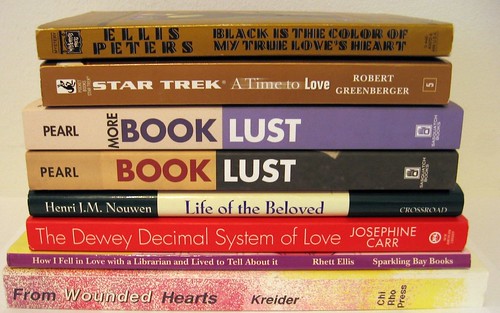
I've kicked around the idea of putting those notes here to share with more than just the people at work, but that would also subject them to reading my rants on other topics. Not that I necessarily mind that. They might, though. The more I think about it, though, the more I'm thinking I'll just post them here. That'll hopefully get me back in the habit of posting things here.
I could clearly be persuaded that another solution would be better. If you've got an idea, let me know in the comments.
Photo by Flickr user eclecticlibrarian.
Wednesday, November 18
In the trenches
Hey there, ladies and gents. It's the middle of National Novel Writing Month and I'm about in the middle of writing my newest novel. I've decided I hate most of the characters' names, but I'm pressing on with the ones I've got. Names can come later. If you're into robot fights and Abraham Lincoln, you may just like this book. I'm not particularly thrilled with it at the moment, but that's probably because I'm in the middle of grinding away on it. I seem to have no problem writing down enough words but I'm not excited about the story itself. Right now, I'm thinking that I'm most excited to just be done with it. I'll catch you up in a bit.
Wednesday, September 16
My feelings about Dan Brown
In case you haven't been paying any attention at all to the world of books, Dan Brown's latest book just came out. With that, I thought I'd share how I feel about his writing style, not him as a person. I don't know the guy, but I'm sure he's an interesting guy to talk to. Now, I know that this could be a potentially divisive post, but I'm hoping to keep it fairly level-headed. I'm pretty good at being objective, but if you think I missed something or that I'm way off base, I'm all for considering your point, as long as you back it up with examples. You can't just leave it with, "You don't know anything about anything, poophead." Now that we've got some ground rules for discourse, here we go.
The first thing I want to say is that the man's books are definitely page-turners. They're the kind of books you pick up and read a chapter and get to the end of that chapter and think, "I just can't stop with that," and thumb through the pages to find out how long the next chapter is. "Oh, that's not too long," you inevitably think to yourself and commit to reading for just a few more minutes so you can finish the next chapter. This process continues until you get to the end, realize that you've just missed that meeting you were supposed to go to, didn't make dinner, didn't take the trash out, and missed your usual bedtime by about two hours. Then you kick yourself for getting so sucked in as you think about how many parts of the story could actually be true.
Having said that, he seems to put comic book characters into his books. They tend to be fairly flat, with their defining characteristics aligned the same general direction. Robert Langdon is just a regular guy who's freaky good at puzzles and codes. Langdon also seems like Superman in that it seems like his hair never really gets messed up, he makes his way through the story relatively unscathed. Sure, maybe he gets beat up every now and then, has to run and hide a couple of times, but he's not like John McClane in Die Hard, bleeding all over the place in his cut-up bare feet, doesn't seem to have a dark side that he indulges when he's on the run and "accidents" could happen. I understand that because he's so smart, he gets to stay just a little bit ahead of the physical danger. But that never seems to help Batman. Batman's the World's Greatest Detective, but he has to get his point across to criminals with his bonecrushing fists.
The last point I want to bring up is how many deep, sinister global conspiracies can there be in the world at a time? Holy crap! And a single guy (Robert Langdon) has dug into all of them? Really? I mean, this is more than Mulder and Scully figured out. They only had to deal with the one about aliens. All the other weird stuff they had to figure out were just unexplained, odd cases. And that was their freaking job! They weren't puppeteers by day, mystery solvers when Uncle Sam called the hotline. They were already FBI agents, so it was their job to dig into conspiracies.
All in all, I think the stories are interesting, the characters aren't. And Mr. Brown sells a lot of stories.
The first thing I want to say is that the man's books are definitely page-turners. They're the kind of books you pick up and read a chapter and get to the end of that chapter and think, "I just can't stop with that," and thumb through the pages to find out how long the next chapter is. "Oh, that's not too long," you inevitably think to yourself and commit to reading for just a few more minutes so you can finish the next chapter. This process continues until you get to the end, realize that you've just missed that meeting you were supposed to go to, didn't make dinner, didn't take the trash out, and missed your usual bedtime by about two hours. Then you kick yourself for getting so sucked in as you think about how many parts of the story could actually be true.
Having said that, he seems to put comic book characters into his books. They tend to be fairly flat, with their defining characteristics aligned the same general direction. Robert Langdon is just a regular guy who's freaky good at puzzles and codes. Langdon also seems like Superman in that it seems like his hair never really gets messed up, he makes his way through the story relatively unscathed. Sure, maybe he gets beat up every now and then, has to run and hide a couple of times, but he's not like John McClane in Die Hard, bleeding all over the place in his cut-up bare feet, doesn't seem to have a dark side that he indulges when he's on the run and "accidents" could happen. I understand that because he's so smart, he gets to stay just a little bit ahead of the physical danger. But that never seems to help Batman. Batman's the World's Greatest Detective, but he has to get his point across to criminals with his bonecrushing fists.
The last point I want to bring up is how many deep, sinister global conspiracies can there be in the world at a time? Holy crap! And a single guy (Robert Langdon) has dug into all of them? Really? I mean, this is more than Mulder and Scully figured out. They only had to deal with the one about aliens. All the other weird stuff they had to figure out were just unexplained, odd cases. And that was their freaking job! They weren't puppeteers by day, mystery solvers when Uncle Sam called the hotline. They were already FBI agents, so it was their job to dig into conspiracies.
All in all, I think the stories are interesting, the characters aren't. And Mr. Brown sells a lot of stories.
Sunday, September 13
getting closer
I've got an idea for something else to include in the next novel, a secondary plot. It involves some heartache, some disappointment, and possibly some ninjas. But not just any ninjas. We'll have to see how that all works out in November.
I know that it's no fun to get teased with no end in sight, no release at all, so I'll totally hook you up. It's just that right now, I don't have anything either. I don't know where it's all going to go or even all the elements I'm going to drag in. I'm almost as in the dark about this as you are. In a couple of months, though, I'll have an idea what I'm doing and I'll get it put together for you as quickly as I can. Since you're all just clamoring for my books anyway. This is a theoretical audience I'm writing to here. Kind of like Twitter feels like I'm posting thoughts to a theoretical group of people who probably don't care much what I have to say, which isn't much at only 140 characters a pop. Pfft.
Friday, September 11
Flash of Genius!
A death-dealing, cybernetically enhanced clone of Abraham Lincoln.

Would you want to take that on? I didn't think so. I wonder where he's going to show up in my upcoming book. Have another brilliant idea you wouldn't mind me stealing and working in somewhere? Share in the comments and I'll include you in a Special Thanks section.
Monday, August 31
Coming soonish
I've started making notes for my next novel. Just as a teaser, ask yourself this question: How much more fun would it be to read about the Brownings' (Robert and Elizabeth Barrett) love for each other if they were space pirates instead of Victorian poets? Well, this next book will not answer that question at all, but it will definitely be fun. I'll be writing it in November as I take part in NaNoWriMo, so you won't see it probably until next year, but if you're jonesing for something entertaining and not at all heavy to read, you might like to read my effort from last year. You can find it on Amazon or at my own personal e-store at CreateSpace.
Tuesday, July 1
Tolstoy's problem
I've been reading War and Peace and I'm doing fairly well, considering it's in another language. But so far, I think I've recognized something that Tolstoy does that I'm not a fan of, but I tend to do myself. He tends to give too much detail about minutiae than I want to bother reading. As I mentioned before, I feel like I tend to do that as well, meaning that's something I'll have to watch out for. If I don't like reading what I write, who else is going to want to read it?
Subscribe to:
Posts (Atom)